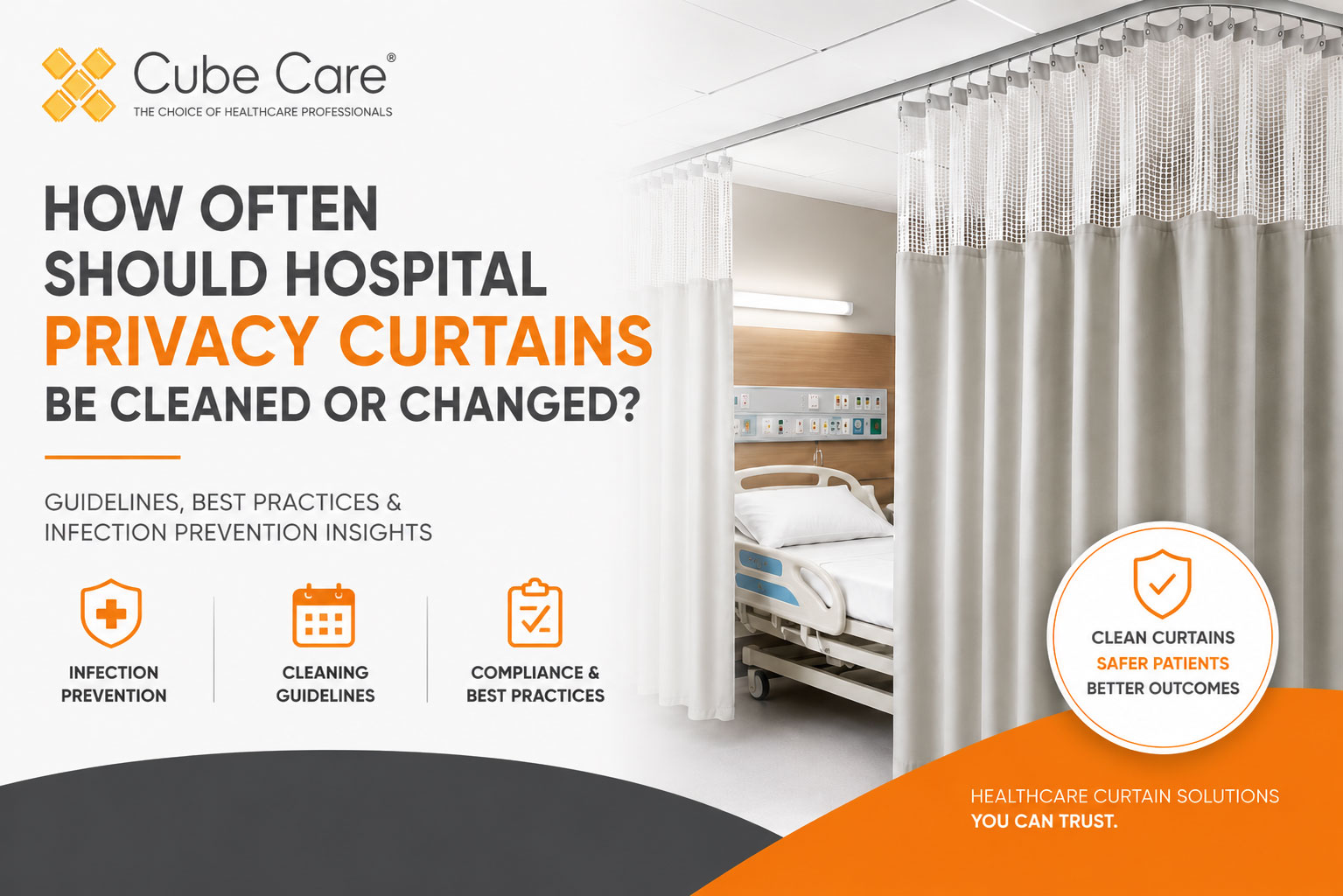
Hospital privacy curtains — also known as cubicle curtains or bed curtains — play a critical role in patient privacy and room separation. However, these frequently touched soft surfaces can also become a hidden source of contamination within healthcare environments.
Studies have shown that hospital privacy curtains can quickly accumulate bacteria, including multidrug-resistant organisms (MDROs) such as MRSA and VRE, due to repeated contact by patients, visitors, nurses, physicians, and environmental services staff.
At Cube Care, we work closely with healthcare facilities to help support curtain compliance programs, infection prevention efforts, and operational efficiency. One of the most common questions we hear is:
“How often should hospital privacy curtains actually be cleaned or changed?”
The answer depends on several risk factors, patient populations, and facility-specific infection control protocols.
Why Hospital Privacy Curtains Matter for Infection Prevention
Unlike hard surfaces that are disinfected multiple times daily, privacy curtains are often overlooked despite being one of the most frequently touched items in a patient room. Common high-touch areas include leading curtain edges, curtain grab zones, entry points near patient beds and nursing access areas.
Research has demonstrated that contamination levels on hospital privacy curtains increase significantly over time. One study found contamination rates increased from 15.6% after 2 weeks to 37% after 4 weeks. This highlights why many healthcare facilities are re-evaluating curtain cleaning schedules and compliance programs.
If your facility is evaluating updated privacy curtain solutions, explore hospital privacy curtain solutions designed specifically for healthcare environments.
Are There CDC Requirements for Privacy Curtain Cleaning?
Currently, the Centers for Disease Control and Prevention does not mandate one universal cleaning frequency for hospital privacy curtains in non-isolation settings. Instead, guidelines recommend a risk-based infection prevention approach. Healthcare facilities should establish written policies in collaboration with Infection prevention teams, Environmental services (EVS), Nursing leadership and Facility operations. Policies should consider patient acuity, unit type, patient turnover, isolation protocols, frequency of curtain contact and visible contamination. You can review the CDC Environmental Infection Control Guidelines for additional recommendations regarding healthcare environmental hygiene and soft surface management.
General Guidelines for Cleaning Hospital Privacy Curtains
Most healthcare facilities follow these core best practices. Always change curtains when visibly soiled, contaminated with blood or bodily fluids, used in isolation rooms after patient discharge and directed by infection prevention teams during outbreaks. For patients on contact precautions or droplet precautions, curtains should typically be removed and laundered before the next patient occupies the room. For high-risk pathogens such as C. difficile, spot cleaning alone is generally not considered sufficient. Curtains should be fully removed and processed through proper healthcare laundering procedures. Many healthcare systems also implement privacy curtain compliance programs to help ensure proper documentation and routine curtain maintenance.
Recommended Cleaning Frequencies by Healthcare Setting
While protocols vary by facility, these are common industry practices:
General Patient Rooms
Typical frequency every 1–3 months, quarterly in lower-risk settings and immediately when visibly soiled. Some hospitals are moving toward every 4 weeks particularly in multi-bed rooms or high-contact areas. Facilities looking for easier maintenance often explore disposable privacy curtain programs to help streamline curtain change-outs and infection prevention efforts.
High-Risk Areas
Including Intensive Care Units (ICU), Oncology, Transplant units, Emergency Departments and Behavioral Health Facilities. Typical frequency every 2–4 weeks, immediately after isolation discharge and sometimes after every patient discharge. These environments often have higher patient turnover, immunocompromised populations, and increased contamination risk. For specialized patient care environments, many healthcare facilities utilize behavioral health privacy curtains and antimicrobial privacy curtain solutions to support both patient safety and operational requirements.
Ambulatory & Lower-Risk Areas
Lower-contact areas may operate on 1–3 month schedules up to 6–12 months in very low-contact administrative settings. However, many healthcare systems still require monthly minimum inspections and regular documentation tracking for compliance purposes. Some facilities also utilize mesh top hospital privacy curtains to help improve airflow and sprinkler system compatibility.
Proper Laundering Is Essential
Hospital privacy curtains should never be treated like residential fabrics. Healthcare-grade laundering should include hot water processing, approved detergents, sanitization cycles and infection control handling procedures. Improper laundering methods may fail to eliminate harmful pathogens and can compromise compliance standards. The Joint Commission and infection prevention teams often expect facilities to maintain documented cleaning and curtain replacement protocols.
Additional Best Practices for Curtain Compliance
Many hospitals now implement additional infection prevention strategies such as Routine Curtain Inspections. Daily EVS rounds can help identify visible contamination, damage or tears, missing tracking labels and high-touch wear zones.
Documentation & Tracking Systems
Facilities often use change-out tags, barcode systems and compliance logs to support regulatory readiness and Joint Commission documentation.
Antimicrobial & Disposable Curtain Programs
Some healthcare systems utilize Antimicrobial privacy curtains, Disposable cubicle curtains and Rapid curtain exchange programs particularly in high-risk patient areas, isolation units, emergency departments and long-term care environments. These solutions can help reduce operational burden while supporting infection prevention initiatives. Learn more about healthcare privacy curtain services and solutions available for hospitals, rehabilitation centers, long-term care facilities, and healthcare systems nationwide.
Factors That Influence Curtain Change Frequency
There is no “one-size-fits-all” schedule. Healthcare facilities should evaluate patient acuity, occupancy rates, multi-bed room usage, community infection trends, isolation frequency, staff traffic and hand-contact frequency. A flexible, risk-based approach often delivers the best balance between infection prevention, operational efficiency, cost management and compliance support.
Supporting Healthcare Facilities with Privacy Curtain Solutions
At Cube Care, we understand that hospital privacy curtains are more than just fabric partitions — they are part of a facility’s overall infection prevention and patient environment strategy.
We provide healthcare-focused solutions including Custom hospital privacy curtains, Disposable curtain programs, antimicrobial curtain options, mesh top configurations, compliance support services and curtain tracking and exchange programs. Our team works with hospitals, behavioral health facilities, rehabilitation centers, long-term care facilities, and healthcare networks nationwide.
Final Thoughts
Hospital privacy curtains are one of the most frequently touched surfaces in healthcare environments, yet they are often overlooked within infection prevention programs. As healthcare facilities continue focusing on patient safety, environmental hygiene, and regulatory readiness, establishing a proactive curtain cleaning and replacement strategy becomes increasingly important.
Because contamination levels can rise quickly — especially in high-touch and high-risk patient care areas — many hospitals are moving toward more structured privacy curtain compliance programs that include routine inspections, documented change schedules, and healthcare-grade laundering processes.
While there is no single universal standard for how often hospital privacy curtains should be changed, healthcare facilities should work closely with infection prevention teams and environmental services leadership to develop policies based on patient populations, room usage, isolation protocols, and operational needs.
At Cube Care, we help healthcare facilities support safer patient environments through customized privacy curtain solutions, disposable curtain programs, antimicrobial options, and compliance-focused services designed specifically for healthcare settings.
If your facility is evaluating ways to improve privacy curtain compliance, infection prevention practices, or operational efficiency, our team is here to help.
Visit www.cubecare.com or call our facility solutions team to request your consultation